First, define what is being released
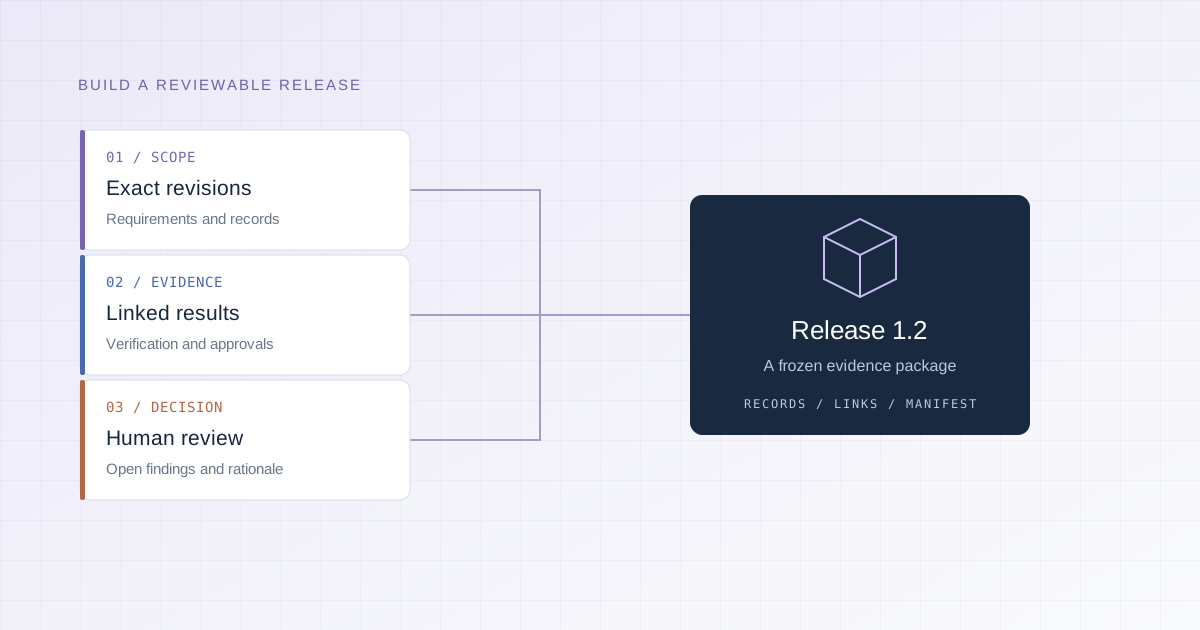
A release review needs a stable subject. Identify the product configuration, the record revisions, and the relationships included in the release. For a connected product, that may span a hardware assembly, firmware, an application, and a service.
Avoid reviewing “the latest” as a moving target. A baseline identifies the versions under review. If an important input changes during the process, record the change and decide which review or verification needs to be repeated.
The checklist
The checks below organize a practical review. Adapt them to your product and responsibilities; they are not a substitute for your organization’s required acceptance criteria.
| Check | What to inspect |
|---|---|
| Scope is defined | Product configuration and included record revisions |
| Requirements are reviewed | Applicable requirements, ownership, and approval history |
| Risk decisions are current | Assessments, controls, and required human decisions |
| Traceability is current | Missing links, changed endpoints, and retired records |
| Verification is applicable | Approved protocols, exact revisions, results, and evidence |
| Failures are resolved | Failed or inconclusive runs, linked retests, and dispositions |
| Quality work is addressed | Open findings, CAPAs, changes, and required follow-ups |
| Documents and training are ready | Approved document versions and required completion |
| Release decisions are recorded | Named technical and quality reviewers |
| The package is inspectable | Documents, evidence, manifest, and artifact checksums |
Read the test result in context
A passing build answers a question about the code and tests that ran. To use that result as controlled verification evidence, connect it to the applicable protocol revision and preserve the identity of the build, commit, and artifacts.
Consider a protocol revised after a CI run. The earlier result may remain useful engineering history, but a later approval cannot retroactively make it evidence of an execution against the newly approved revision. Check the sequence as well as the outcome.
Keep failed and inconclusive results. A linked retest explains how the team followed up. Replacing the earlier result with the passing one loses information reviewers may need to understand the decision.
Make open work specific
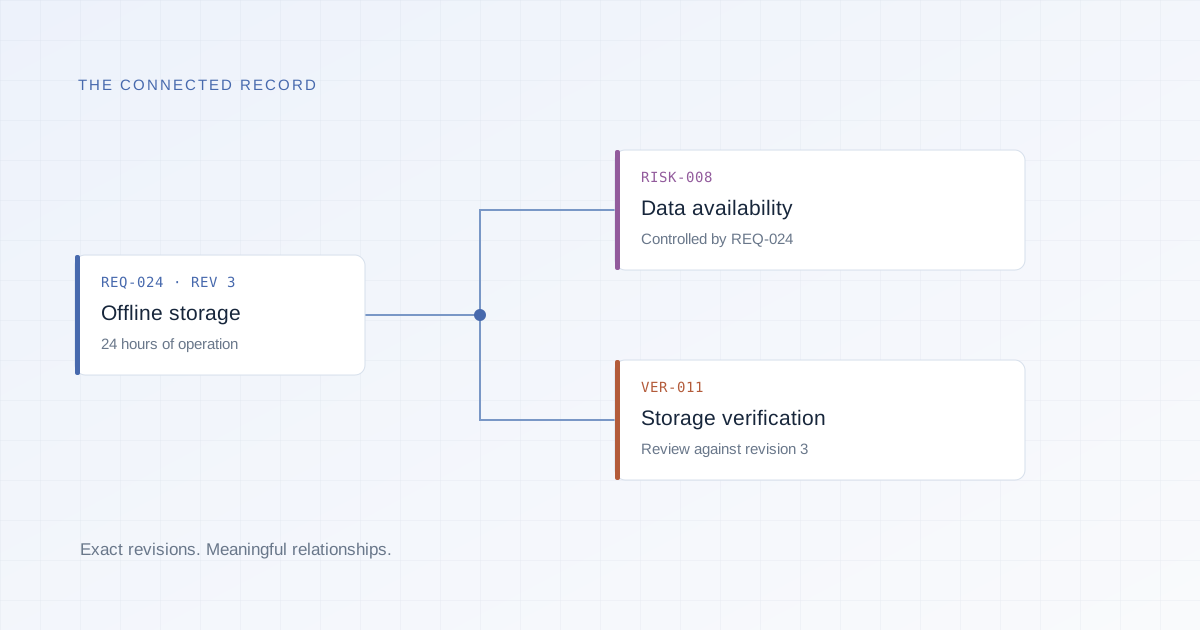
A useful readiness finding says which record, which revision, and which condition needs attention. “Verification incomplete” is less actionable than “TEST-018 revision 4 still covers 12 hours; REQ-024 revision 3 requires 24.” The latter gives the owner a concrete starting point.
Assign responsibility for resolving each finding and keep the resolution with the record. Some findings require new work. Others require clarification or an explicit decision. The checklist should preserve that difference instead of becoming a collection of unchecked boxes with no next step.
Preserve the release decision
After review, freeze the baseline and retain the evidence used to support it. The next development revision should not change the historical release. Keep a manifest that identifies what the package contains, and checksums that let a recipient check artifact integrity.
An exported package should be understandable outside the original application. Include readable documents and structured data where useful, with enough identifiers and revision context to connect the files back to the release decision.
Benchform brings readiness findings, exact-revision baselines, human approvals, and export packages into one workflow. The software helps organize and preserve the record; your team remains responsible for deciding whether the product is ready.
Download the release checklist
Markdown · editable checklist
Put the workflow in context
Release evidence in Benchform
Bring the reviews, tests, and product decisions together before a release. Preserve the exact revisions and evidence that supported the decision.
Explore release evidence