Start with the relationship
Requirements traceability connects a product requirement to its origin, implementation, risks, and verification. The relationship should explain something. A user need defines why the requirement exists; a risk control addresses a hazard; a test protocol describes how the intended behavior will be checked.
A useful matrix therefore needs more than two IDs in adjacent columns. Give the link a type and retain the revisions at both ends. “REQ-024 is verified by TEST-018” is a statement about particular content, not every future version of those records.
Begin with a small vocabulary that the team understands. Adding relationship types is easy; agreeing on what each one means is the important work. A reviewer should be able to follow the link without guessing why it was created.
A worked example: offline storage
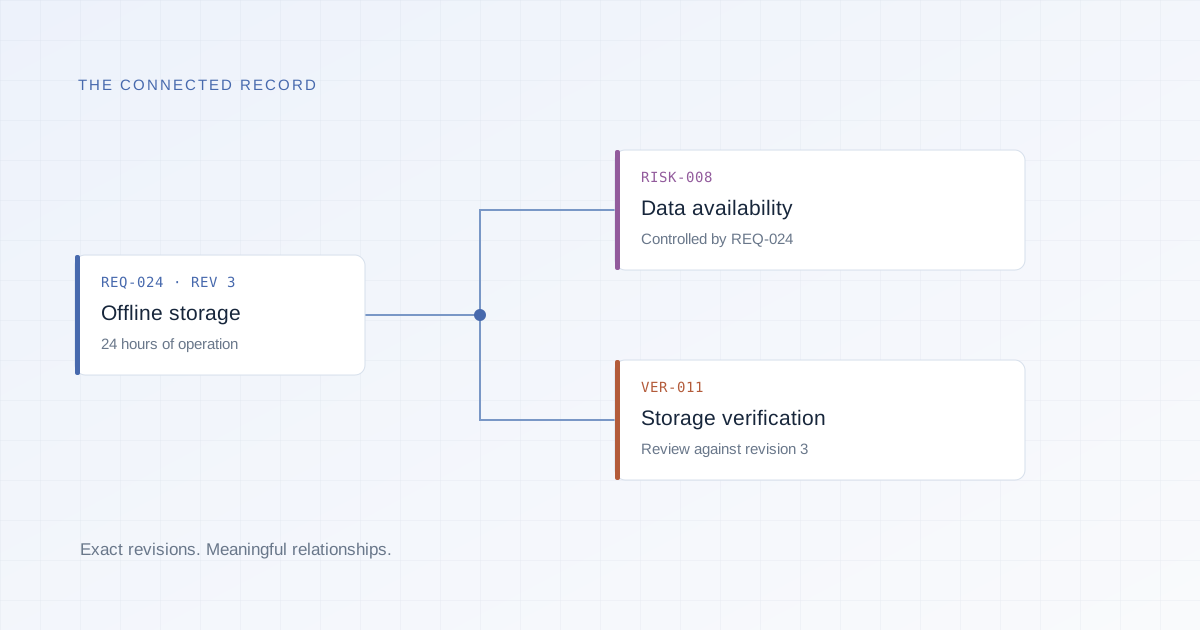
Consider a field sensor that must keep recording without a network connection. The team identifies a need for uninterrupted data collection, writes a storage requirement, assesses the risk of data loss, and defines a verification protocol. The following records are illustrative.
| Source | Relationship | Target | State |
|---|---|---|---|
| UN-004 r1 · Continuous recording | Defines | REQ-024 r2 · 12-hour storage | Reviewed |
| REQ-024 r2 · 12-hour storage | Controls | RISK-007 r2 · Data loss | Reviewed |
| REQ-024 r2 · 12-hour storage | Verified by | TEST-018 r4 · Offline recovery | Reviewed |
| TEST-018 r4 · Offline recovery | Supported by | RUN-031 r1 · Test execution | Evidence recorded |
Now change 12 hours to 24
The requirement advances to revision 3. The old verification result still exists, and it may still be valid evidence for the old release. It does not automatically demonstrate the new 24-hour behavior.
Mark the relevant relationships as needing review. Inspect the risk control, protocol duration, available storage, and any affected interfaces. Record the assessment and decide which work needs revision, new evidence, or a documented rationale for reuse.
Preserving the older records matters. Overwriting the test result would erase how the previous release was supported. A frozen release baseline and a current working view answer different questions and should both remain available.
- Identify the changed revision.
- Inspect direct links and downstream relationships.
- Record the affected records and releases.
- Update the applicable work and verification.
- Review the resulting links and retain the assessment.
Coverage is a check, not a conclusion
A coverage check can tell you that a requirement has no verification link, that a linked endpoint changed, or that a record was retired. It cannot decide whether the test is well designed or the evidence is persuasive. Structural completeness and technical adequacy require different kinds of review.
Make those distinctions visible. “Missing” means the expected relationship is absent. “Needs review” means a relationship exists but its current applicability is unresolved. “Reviewed” describes a decision about a specific relationship and set of revisions; it should not be an evergreen green checkbox.
Make the matrix maintainable
Give records stable identities, name the owners, and make the matrix a view of the underlying work. People should be able to open a source, inspect its history, and understand the linked revision. Exporting the matrix is useful, but the export should retain enough context to be interpreted later.
During review, pick a few important requirements and follow their complete paths. Check the rationale, the current relationship, the protocol, the execution, and the evidence. This is often more revealing than scanning a page of completed cells.
Benchform uses revision-aware links, coverage checks, focused graphs, and recorded impact assessments to support this workflow. Your team still owns the judgment about what the product needs and whether the evidence is adequate.
Download the example matrix
CSV · illustrative records
Put the workflow in context
Traceability & change in Benchform
Follow the connections between requirements, risk, verification, and releases. Find the gaps and identify which decisions need another look.
Explore traceability & change