Two responsibilities, one product
A quality management system organizes how an organization defines, performs, reviews, and improves its quality work. That can include controlled procedures, training, supplier activities, investigations, corrective actions, audits, and management review. Software supports the system; it does not create an effective quality practice on its own.
Application lifecycle management organizes the work of defining, building, verifying, changing, and releasing software. In a product that combines hardware and software, related lifecycle records may also cover system requirements, components, interfaces, manufacturing transfer, and configuration.
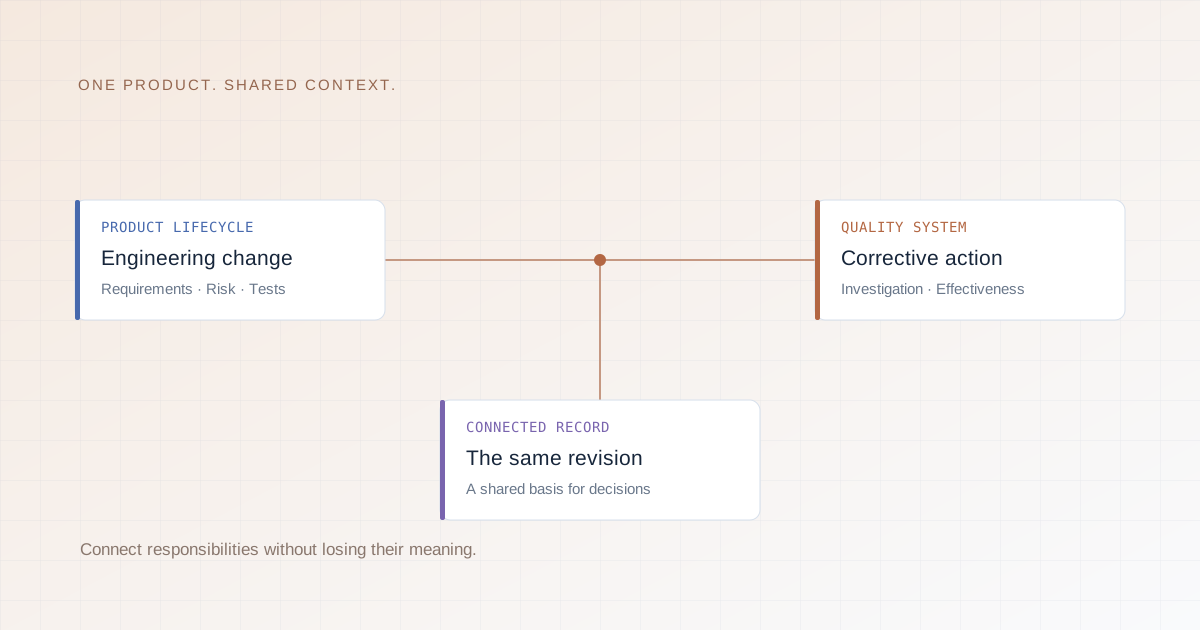
The boundaries are useful for assigning responsibility. They become less useful when they prevent an engineering change from staying connected to the quality activity that prompted it.
Where the work connects
These examples are a practical way to think about the overlap. A team may assign the responsibilities differently, but the underlying relationships still need a record.
| Product work | Quality work | Shared record |
|---|---|---|
| Revise a requirement | Review the controlled change | Reason, affected revisions, approvals |
| Investigate a field issue | Manage a complaint or CAPA | Investigation and corrective action |
| Change a test procedure | Control the document and retrain | Approved revision and training |
| Replace a component | Reassess the supplier and risk | Impact assessment and verification |
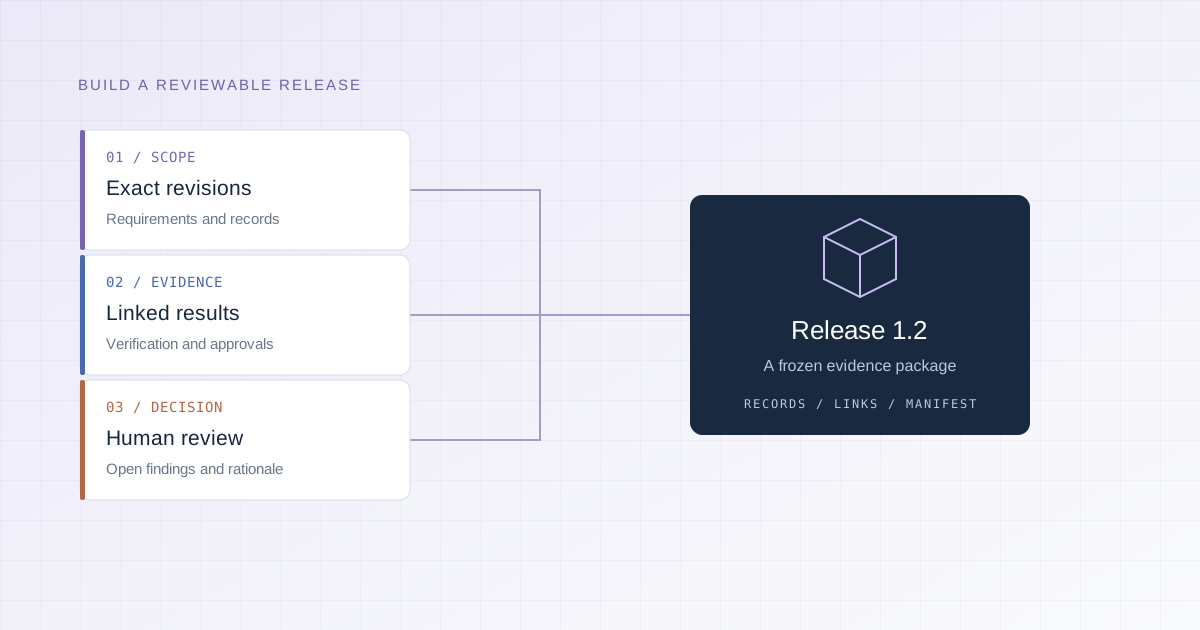
| Prepare a release | Review completeness and evidence | Frozen baseline and release decision |
Follow one issue across the boundary
Imagine a connected sensor whose readings are lost during a network outage. A quality record captures the report and supporting material. An investigation identifies a gap in the storage behavior. Engineering revises the requirement, updates the implementation, and records verification of the new behavior.
The change also affects a support procedure. Its revised version goes through review, and the appropriate people receive training on that exact revision. The corrective action closes only after the required follow-ups and evidence are complete.
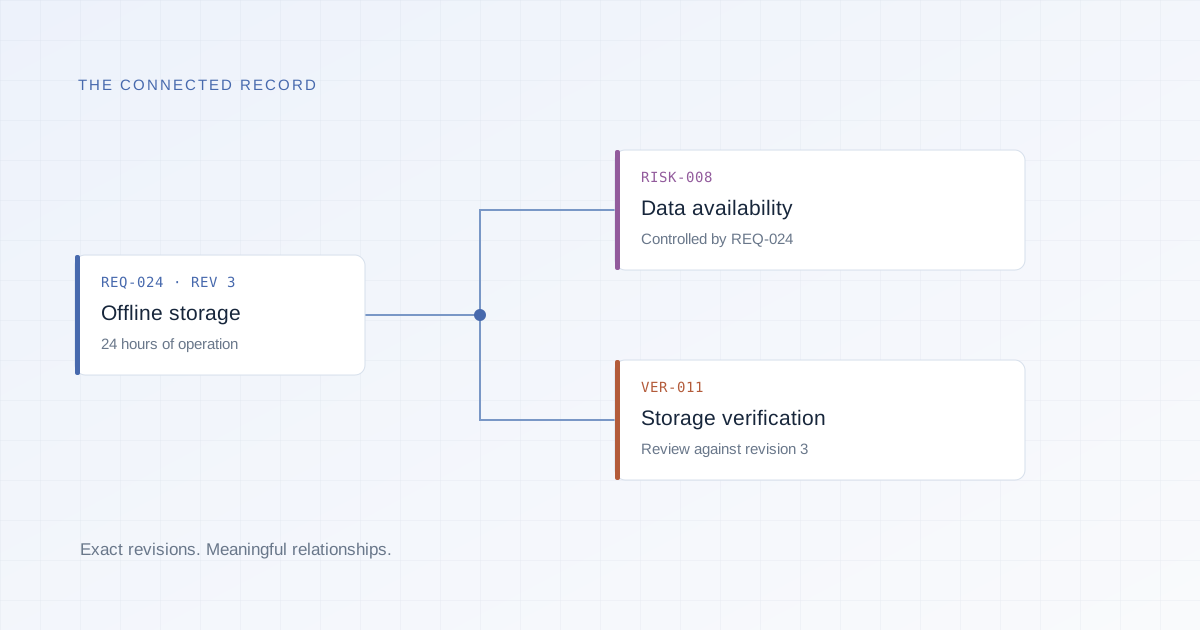
There is no single document that can explain the whole sequence well. A connected set of records can: the original report, investigation, requirement revision, test evidence, procedure revision, training, and closure decision each retain their purpose and history.
Evaluate a workflow, not a feature count
When comparing tools, bring one representative change from your own product. Ask how it begins, who reviews it, which records it affects, how evidence is added, and what remains visible after release. Try the awkward parts: a failed test, a revised procedure, an incomplete follow-up, or an outdated link.
A useful evaluation will reveal where the system supports your team’s decisions and where configuration or process work is still needed. No list of modules can answer that as well as walking through the work.
Benchform brings product lifecycle records and quality operations into a shared model. It is being used internally at Dyno while qualification continues; early access is an opportunity to evaluate the workflows with us.
Put the workflow in context
Quality management in Benchform
Bring documents, training, investigations, and corrective actions into the product workflow. Keep the owner, the next step, and the evidence in view.
Explore quality management